Small LLM Pretraining
A long-running playground project for pretraining small language models (~100M-200M parameters) from scratch. Over time it has become the main test bed for the LM Training Project template, and this README is as much a changelog of what has been tried here as it is a getting- started guide.
If you are looking for the full reference on every training argument and dial that the template exposes, read the LM Training Project documentation and the Trainer Options Reference. This README focuses on this particular project: its defaults, its sub-projects, the configs we ship, and the experiments that have been run.
What This Project Is
- A concrete LM training project that extends
lm_training_project.yamlwith choices appropriate for pre-training a small model on a few consumer GPUs. - A set of ready-to-run configurations covering precision experiments, LR schedules, alternative architectures, and a curriculum dataset.
- Two sub-projects under this directory that demonstrate how to plug a custom model or a custom dataset into a training project without vendoring everything into the top-level project:
custom_canon/- a custom model sub-project that shows how to build a Llama variant with Canon-A layers and NoPE while inheriting from the regular Llama model project.tiny-stories_small-lm/- a dataset sub-project that demonstrates a soft curriculum, interleaving Tiny Stories with SmolLM corpus viasoft_sequentialsampling.
Defaults
All experiments below were run on 4 GPUs (4x RTX 3090 / equivalent), DDP, with sequence packing at 4K tokens.
| Setting | Default |
|---|---|
| Model | vanilla examples/models/llama/medium.yaml |
| Trainer | ddp |
| Precision | AMP bf16 (mixed_precision: bf16), weights in fp32 |
| Attention | flex_attention |
torch.compile |
enabled, max-autotune |
| Sequence length | 4096 |
| Per-device batch size | 4 |
base_lr |
1.5e-4 (sqrt-scaled to global batch) |
base_batch_size |
16384 (LR scaling reference) |
| LR schedule | InfiniteLRScheduler with rsqrt annealing |
| Cooldown | cooldown_p = 0.3, min_cooldown_tokens = 6.8B |
| Token budget | 2.27B (1x Chinchilla for the default model) |
| Fused loss | forgather.ml.loss:LinearCrossEntropyLoss |
| Optimizer | torch.optim.AdamW |
| Grad clipping | max_grad_norm: 1.0 |
The default 2.27B-token budget is Chinchilla-optimal for the default model.
From forgather model construct on examples/models/llama/medium.yaml:
Total:             162M
Trainable:         162M
Embedding:         49.2M
Non-embedding:     113M
Tied embeddings:   False
Chinchilla tokens: 2.27G
FLOPs/token:       6.80e+08
Default Model: vanilla Llama (medium)
The project used to default to a custom DeepOne model. It now defaults to the
plain examples/models/llama/medium.yaml config - a vanilla Llama at
roughly the same parameter count as the old DeepOne default, but with
predictable behaviour and no bespoke architecture to reason about. The
DeepOne model is still reachable via -t deepone.yaml, and the custom
Canon variant lives in the custom_canon/
sub-project.
Default Dataset: SmolLM-Corpus (interleaved + packed)
The default training dataset is the smollm-corpus/interleaved-packed.yaml
config of the examples/datasets/HuggingFaceTB/
dataset project. It is the packed variant of an interleaved mix of two
subsets of HuggingFaceTB/smollm-corpus:
fineweb-edu-dedup- a deduplicated, quality-filtered slice of FineWeb-Edu. Real educational web content.cosmopedia-v2- Hugging Face's synthetic-text-books corpus of generated educational content, stories, and Q&A.
SmolLM-Corpus is a large (~600B token) curated mix assembled for training small language models, where sample efficiency matters more than sheer volume. It trades breadth for signal density, which is the right choice when you're training a ~100M-parameter model on a consumer-GPU budget.
Interleaved: The two subsets are merged with
forgather.ml.datasets.interleave_datasets using the
balance_remaining_examples sampling policy - on each draw, the
probability of each subset is proportional to its remaining unseen
examples. This keeps both subsets at roughly the same depletion rate
rather than exhausting one before the other. stopping_strategy:
all_exhausted means the combined iterator continues until every subset
has been seen.
Packed: Each subset is pre-tokenised and packed into fixed-length
sequences (default 4096 tokens to match the project's seq_len). Packing
concatenates short examples into full-length blocks with attention masks
that prevent cross-example attention, so no tokens are wasted on padding
and every batch is fully utilised. This is what makes the 4K-token
sequence length cheap - without packing, short FineWeb pages would each
produce a mostly-padded batch element.
First-run download: The initial load downloads the full dataset
(~100GB+) and tokenises it; subsequent runs hit the on-disk cache and
load near-instantly. Downloads and cached tokenisations live under
datasets/ at the repo root; see the
HuggingFaceTB dataset project README
for the full set of available configs (fineweb-edu-packed,
cosmopedia-v2-packed, the non-packed variants, etc.) and how to select
one via --dataset-config.
Quick Start
Auto-resume is the default: running forgather train picks up the latest
checkpoint if one exists, and starts fresh otherwise. There is no need to
pass --resume flags in the common case.
# Train with defaults (vanilla Llama medium, 2.27B tokens, 4 GPUs)
forgather train

# Train for longer (23B tokens instead of 2.3B)
forgather train --total-tokens 23000

# Use SDPA attention and disable torch.compile for faster startup
forgather train --compile false --attn-implementation sdpa

# Swap in a different model project / config
forgather train \
    --model-project ../../models/llama/ \
    --model-config small.yaml

# List the ready-made configs in this project
forgather ls
Most options documented in the
LM Training Project reference
apply here unchanged - this project only overrides a handful of defaults on
top of lm_training_project.yaml. See
templates/project.yaml for the exact overrides.
Configurations
| Config | Purpose |
|---|---|
default.yaml |
Baseline. Same as project.yaml - 1x Chinchilla, AMP bf16, Llama medium. |
bf16.yaml |
Pure bf16 weights + SR, Forgather's AdamW. lr = 4e-4. |
bf16_adafactor.yaml |
Pure bf16 weights + SR, Adafactor. lr = 1e-3. |
high_lr.yaml |
AMP at the highest non-diverging LR we could find (3e-4). |
canon.yaml |
Custom Canon-A + NoPE variant from the custom_canon/ sub-project. |
muon.yaml |
Muon optimizer (torch.optim:Muon) at lr = 6e-4, AdamW for non-matrix params. |
deepone.yaml |
Old default - DeepOne medium with trainable ALiBi. |
tiny_x_small_lm.yaml |
10x Chinchilla curriculum: Tiny Stories softly transitioning into SmolLM-corpus, then annealed. |
ten_chinchilla.yaml |
Baseline extended to 10x Chinchilla + 1x annealing. |
long_cooldown.yaml |
10x Chinchilla with cooldown_p = 0.7. |
wsd.yaml |
10x Chinchilla with the WSD-S scheduler from forgather.ml.optim:WSDScheduler. |
final.yaml |
10x Chinchilla combining the most promising knobs: Tiny Stories x SmolLM curriculum, lr = 3e-4, WSD-S scheduler. |
pp.yaml |
Pipeline Parallel trainer variant of the baseline. |
Unless otherwise noted below, each of the 1x Chinchilla configs uses the baseline LR schedule, so their loss curves are directly comparable to the first 1x of the 10x runs.
Sub-Projects
custom_canon/ - custom model demonstrator
custom_canon/ shows how to build a custom
model architecture as a sub-project of a training project, without
forking the underlying model project. It extends
examples/models/llama_canon/ and defines
a "Canon-A only + NoPE + QK-Norm" variant sized to match Llama medium
exactly (hidden_size=768, intermediate_size=2048, 16 layers, 8
heads) so the eval-loss comparison is head-to-head at matched compute.
The sub-project README covers the four Canon insertion points
(A/B/C/D from Allen-Zhu's
Physics of Language Models: Part 4.1,
2025), why this specific subset was chosen (informed by the more
thorough 4M ablation in
tiny_experiments/canon),
and what to try next given the parent project's 1x result.
This sub-project is the intended pattern for adding a custom
architecture to an experiment: treat the custom model as its own
Forgather project, then point the training project at it via
--model-project (or by committing a config like canon.yaml that
sets ns.model_project_dir).
tiny-stories_small-lm/ - curriculum dataset demonstrator
tiny-stories_small-lm/ is a
dataset sub-project that demonstrates a soft curriculum: it
interleaves roneneldan/TinyStories with the default
HuggingFaceTB/smollm-corpus packed mix using
forgather.ml.datasets.soft_sequential, which smoothly transitions
the sampling weight from the first dataset to the second over the
course of training. The geometric framing: each dataset is an
attractor in parameter space, and a soft curriculum slides the
attractor instead of jumping it.
The sub-project README documents the underlying maths (the
two-dataset case collapses to exponential decay of the first
dataset's draw probability with time-constant N_TS), the prior-work
landscape (closest neighbour: Saffronwala et al.,
Curriculum-Guided Layer Scaling,
2025; the smooth-vs-concat ablation appears to be an open gap in the
literature), and a proposed experiment design that would fill that
gap.
The tiny_x_small_lm.yaml config plugs this sub-project in as the
training dataset. The pattern is the same as for models: the dataset
lives in its own Forgather project, and the training config points at
it via ns.dataset_proj / ns.dataset_config.
Experiments
All experiments in this section were run on 4 GPUs. The plots below are
generated with forgather logs plot.
10x Chinchilla runs
These are long runs at 10x Chinchilla (~22.7B tokens) followed by a 1x
Chinchilla (~2.27B tokens) annealing phase. The LR schedule before the
annealing phase is the same as the 1x baseline (for the Infinite-LR runs),
so the first 10% of training is directly comparable to the 1x runs. The
WSD-based runs (wsd, final) use a different scheduler shape over the
same total budget.
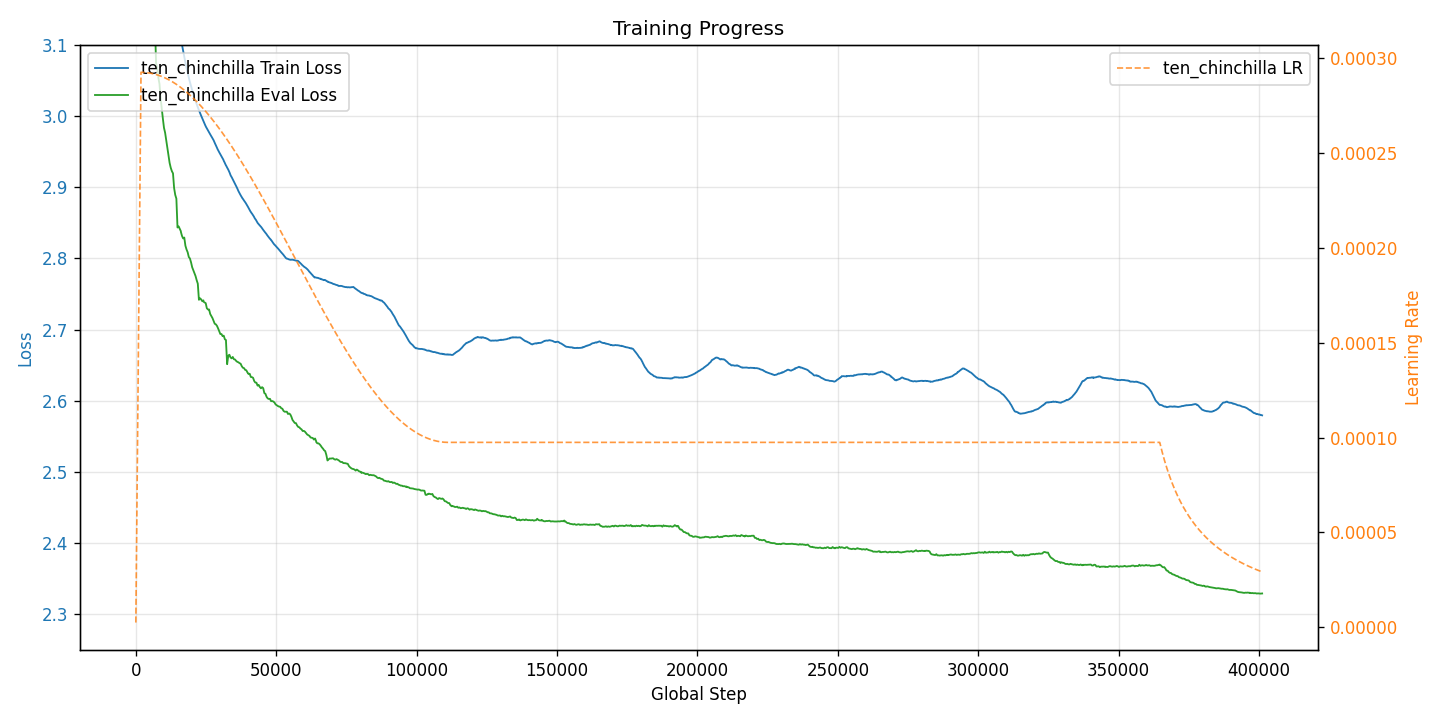
The LR trace from the baseline ten_chinchilla.yaml run makes the Infinite
LR schedule concrete: a short warmup ramp, a cosine cooldown from peak
(~3e-4 at the scaled global batch) down to constant_lr (~1e-4) over the
first ~30% of training, a long stable phase, and a final rsqrt annealing
phase that was triggered after the fact via --start-annealing. The loss
drops visibly in the annealing region.
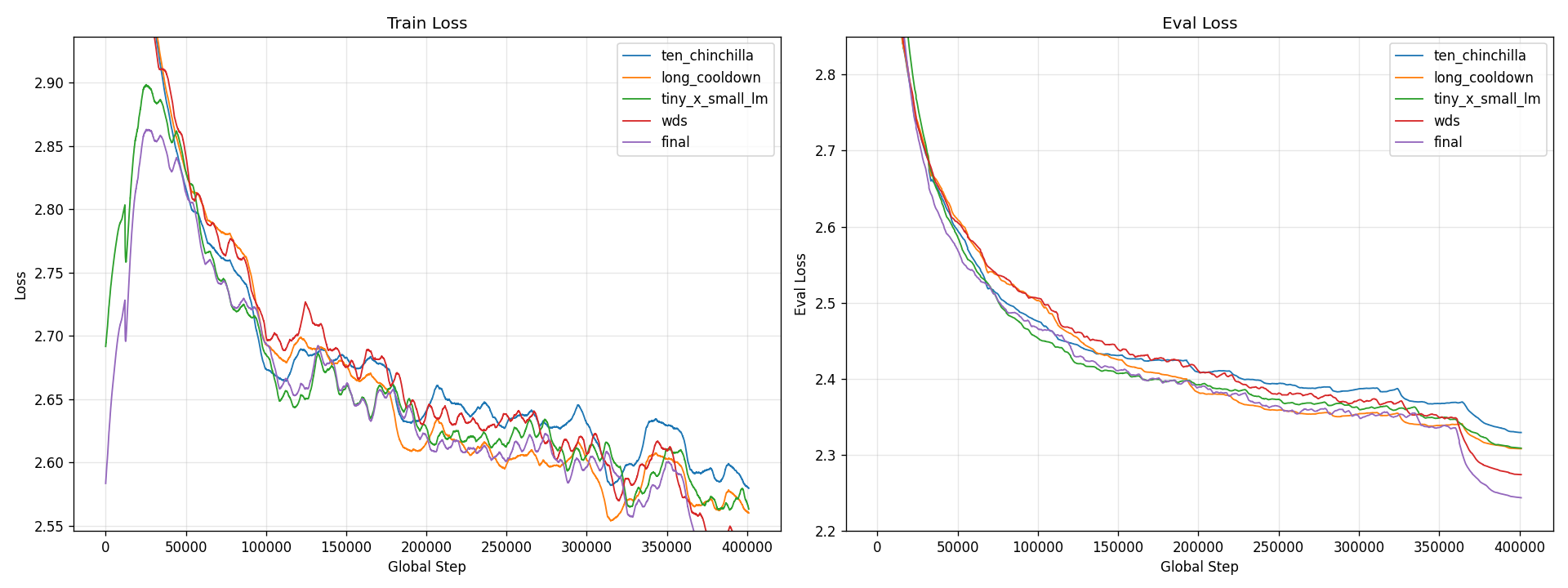
Side-by-side comparison of the five 10x configs. final (curriculum +
lr=3e-4 + WSD-S) ends with the lowest eval loss; wds (WSD-S on the
default dataset and LR) is next; long_cooldown and tiny_x_small_lm
finish in a near-tie behind that; ten_chinchilla is last. The rising
train-loss noise band from ~step 100K onwards in the Infinite-LR runs is
the constant_lr phase - there is no more decay, so per-step variance
stays high even while eval loss keeps improving. The WSD-S runs show a
similar plateau in the stable phase and a sharp drop during the decay
window at the end.
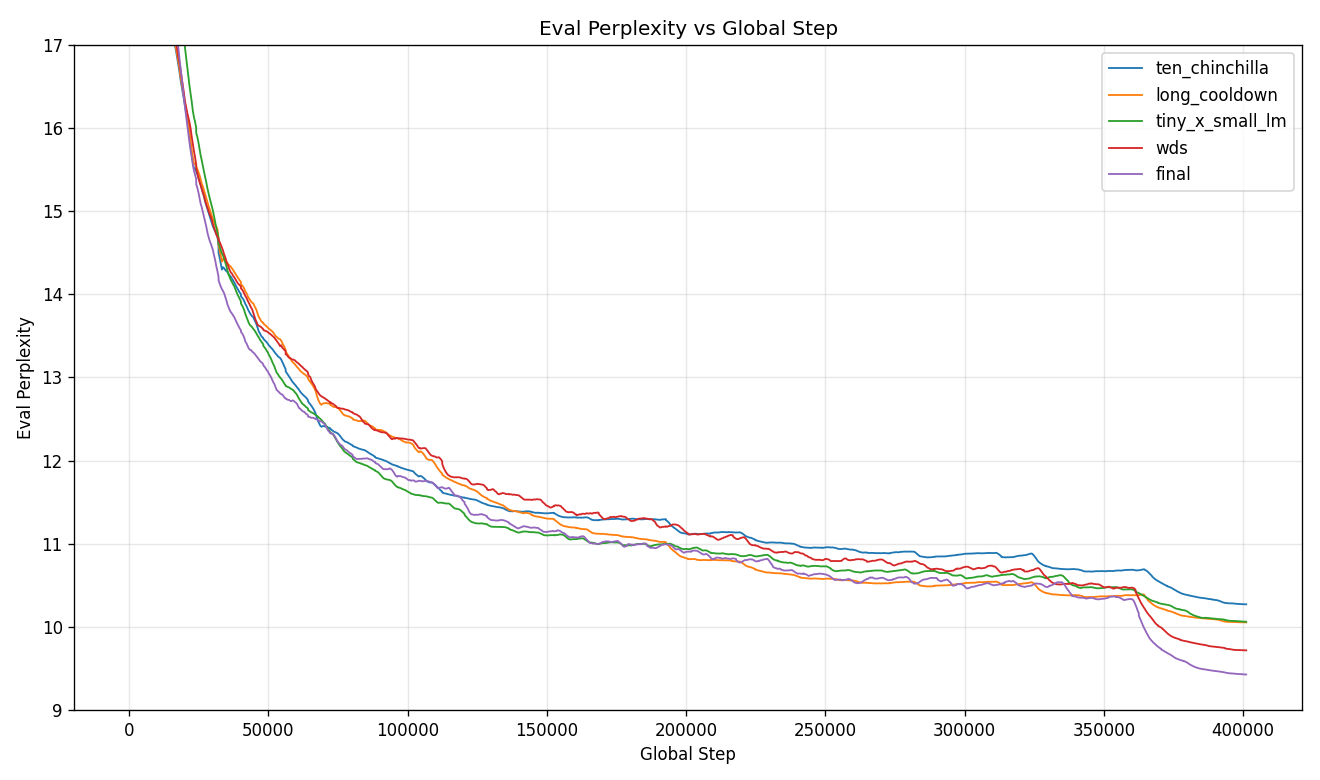
Same eval losses plotted as perplexity on a linear axis (outlier-clipped to
the late-training tail). Perplexity on a linear scale is the natural view
for this data - log-perplexity is just loss, so it would collapse back to
the previous plot. The end-of-run separation between final and the rest
is most visible here:
All four non-final configs change exactly one variable from
ten_chinchilla, so each row's Δ column is the marginal effect of
that single change. final combines three changes at once and is not
directly attributable.
| Config | Single change vs baseline | Best eval loss | Best perplexity | Δ eval |
|---|---|---|---|---|
ten_chinchilla.yaml |
(baseline: Infinite-LR, cooldown_p=0.3, default dataset, lr=1.5e-4) |
2.329 | 10.27 | — |
long_cooldown.yaml |
cooldown_p: 0.3 → 0.7 |
2.308 | 10.05 | −0.021 |
tiny_x_small_lm.yaml |
dataset: SmolLM → Tiny Stories × SmolLM curriculum | 2.309 | 10.06 | −0.020 |
wsd.yaml |
LR scheduler: Infinite-LR → WSD-S | 2.274 | 9.72 | −0.055 |
final.yaml |
curriculum + WSD-S + lr 1.5e-4 → 3e-4 (combined) |
2.244 | 9.43 | −0.085 |
The single-variable improvements all point in the same direction. Of the three knobs we've tested individually, WSD-S is the largest single contributor (−0.055), with the cooldown-shape and curriculum-dataset changes coming in roughly equal at about a third of that.
ten_chinchilla.yaml - output_models/ten_chinchilla
The baseline extended to 10x + 1x with cooldown_p = 0.3. Best eval loss
2.329 at step 400334.
Note: this run was not originally launched from ten_chinchilla.yaml -
the config was reverse-engineered afterwards to match what actually ran.
The run was started from the baseline with --total-tokens 24970, and the
annealing phase was triggered after the fact using the new
--start-annealing / forgather control path. The TensorBoard logs
appear to have been updated correctly, and the JSON logs should have been
appended to as well, though that has not been confirmed end-to-end. The
baseline config would produce an identical training trajectory if
truncated to 2.27B tokens.
long_cooldown.yaml - output_models/long_cooldown
Same as above, except cooldown_p = 0.7 - the cosine cooldown runs over
70% of the initial 10x token budget instead of 30%. Best eval loss
2.308 at step 399131 (lower than ten_chinchilla).
As with ten_chinchilla, the annealing phase was added after the fact.
The technique was slightly different - ns.decay_start_step was edited
from -1 to trigger annealing - and the resulting rounding error in the
step count produced a small discontinuity at the start of the annealing
phase. The overall profile is still close to ten_chinchilla.
The interesting observation is in the validation-loss curve: long_cooldown
stays above ten_chinchilla until around step 140K, at which point it
overtakes and finishes with a notably lower perplexity. This is consistent
with the intuition that stretching the high-LR phase helps late-training
convergence when you have the compute budget to pay for the slower early
progress.
tiny_x_small_lm.yaml - output_models/tiny_x_small_lm
The curriculum-dataset run (Tiny Stories softly transitioning into
SmolLM-corpus, see tiny-stories_small-lm/),
extended to 10x Chinchilla + a 1x annealing phase to match the rest of
this group. Best eval loss 2.309 at step 400688. The eval-loss curve
shows a faster early drop than the pure-SmolLM Infinite-LR runs - this is
the Tiny Stories phase keeping the train loss artificially low - but the
curve crosses back as the curriculum hands off to SmolLM, and the run
finishes essentially tied with long_cooldown and ahead of
ten_chinchilla.
Compared against the matched ten_chinchilla baseline (only the
dataset differs), the curriculum buys ~0.020 eval loss (2.309 vs
2.329).
Beyond the eval-loss number, the curriculum also produces qualitatively different early-training behaviour. Generation samples in the first half of training carry an obvious children's-story register that the pure-SmolLM runs don't have, and the model is producing coherent short narratives noticeably earlier. The eval split is SmolLM-only, so any Tiny Stories-specific patterns that don't transfer never show up in the eval-loss number - so the eval-loss delta is plausibly a lower bound on the actual benefit if you care about mid-training generation quality.
The dataset sub-project's README documents the soft-sequential maths (exponential decay of the first dataset's draw probability), the prior-work landscape (the smooth-vs-concat head-to-head appears to be an open gap), and a proposed ablation that would isolate the schedule's contribution from the LR schedule it's run under.
wsd.yaml - output_models/wds
Replaces the Infinite-LR scheduler with WSD-S
(forgather.ml.optim:WSDScheduler): linear warmup, then base_lr is
held flat through the long stable phase, then a harmonic/rsqrt decay
to min_lr over the final 1x budget. Same dataset and base_lr = 1.5e-4
as the baseline. Best eval loss 2.274 at step 399485 - a −0.055
improvement over ten_chinchilla, the largest single-knob effect of
any 10x run.
Both schedules share the same decay-phase math - small-llm overrides
annealing_type: "rsqrt" in project.yaml, so the Infinite-LR runs in
this project use the same harmonic/rsqrt decay formula that WSD-S uses
(linear interpolation of inverse LR; see wsd_scheduler.py and
infinite_lr_scheduler.py). The difference is what happens before
the decay phase:
- Infinite-LR: warmup → cosine cooldown from
base_lr(~3e-4 at the scaled global batch) down toconstant_lr(~1e-4) over the first ~30% of training (cooldown_p = 0.3forten_chinchilla, 0.7 forlong_cooldown) → long stable plateau atconstant_lr→ rsqrt annealing tomin_lr. - WSD-S: warmup → long stable plateau at
base_lr(no cosine cooldown phase) → rsqrt decay tomin_lr.
So WSD-S keeps the LR at base_lr through the entire pre-decay portion
instead of dropping it to constant_lr. The other scheduler-only
change, long_cooldown, moves in the same direction by delaying when
the cosine drop completes (cooldown over 70% instead of 30%), and gets
a smaller win (−0.021). The pattern across all three is consistent:
spending more of the pre-decay budget at higher LR helps eval loss,
with WSD-S at the extreme end of "all of it at peak" winning by the
largest margin.
final.yaml - output_models/final
The "best knobs we have so far" combination: curriculum dataset + lr =
3e-4 (matching high_lr.yaml) + WSD-S scheduler, run for the same 10x +
1x budget. Best eval loss 2.244 at step 401042 - the best 10x result
in this project so far, an improvement of −0.085 over
ten_chinchilla.
How does that decompose? The single-knob deltas were curriculum −0.020
and WSD-S −0.055; we have no isolated lr=3e-4 10x control, only the
1x high_lr.yaml result (which beats default 1x by ~0.013, not
necessarily extrapolable to 10x). Naively summing the two known knobs
gives −0.075, leaving roughly −0.010 for the LR change plus any
non-additive interaction. So most of final's lead is the WSD-S
scheduler and the curriculum stacking cleanly; the LR bump from 1.5e-4
to 3e-4 is plausibly a smaller contributor.
A long_cooldown-style cooldown shape was not combined with the
other knobs here, so the next experiment in this direction would be a
final.yaml variant with cooldown_p = 0.7 (or its WSD-S analogue) to
see whether stacking the cooldown change on top picks up roughly
another −0.020.
1x Chinchilla runs
These runs share the baseline LR schedule over the 1x budget, so they are
directly comparable. The default series in the plots below is the first
~36.4K steps of the ten_chinchilla run, clipped with --x-max - since
the cooldown floor (min_cooldown_tokens = 6.8B) dominates both the 1x
and 10x configs, the first 1x interval of ten_chinchilla is on exactly
the same LR schedule as a standalone default run, so it serves as a
zero-cost stand-in for the baseline.
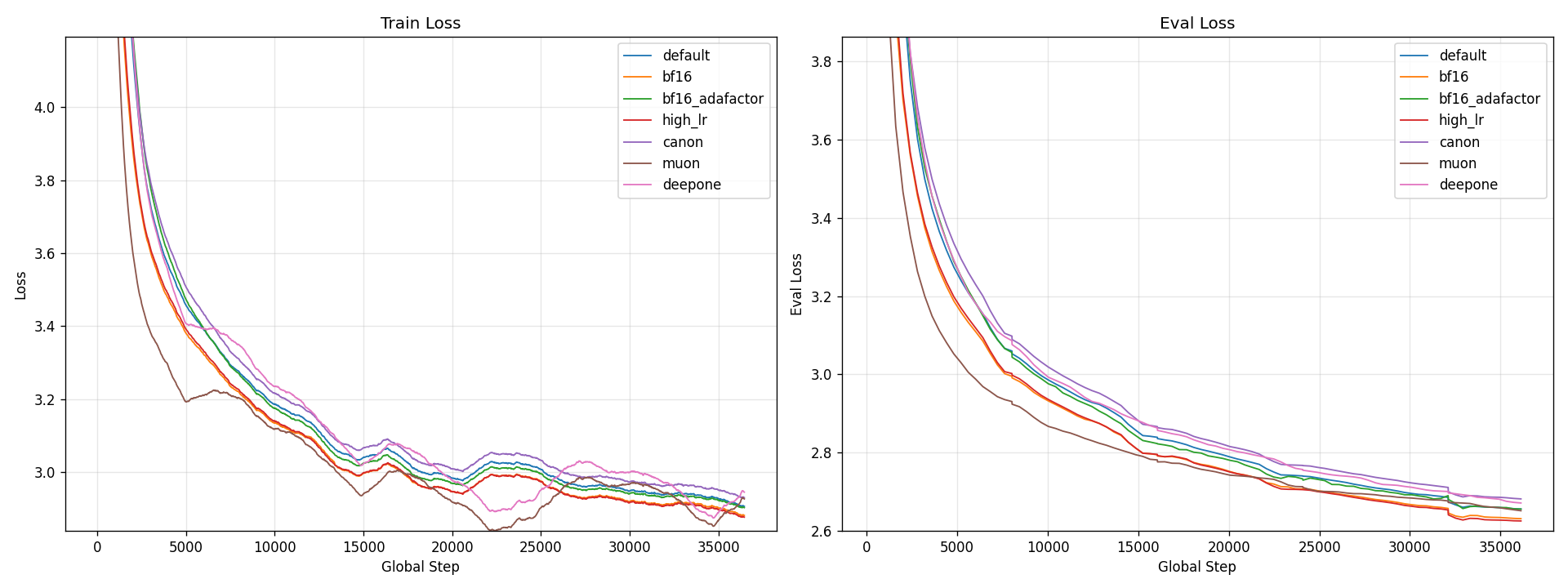
The standout in the train-loss panel is muon - it drops well below every
AdamW-based run for most of training, only converging back into the bundle
near the end. On the eval panel (right) the order tightens up: high_lr
and bf16 finish at the bottom, the AdamW default slice is just behind
them, and muon, bf16_adafactor, deepone, canon all finish within a
narrow band roughly 0.03-0.06 above the leaders. Despite the dramatic
train-loss lead, Muon's eval loss does not beat the best AdamW run at this
compute budget.
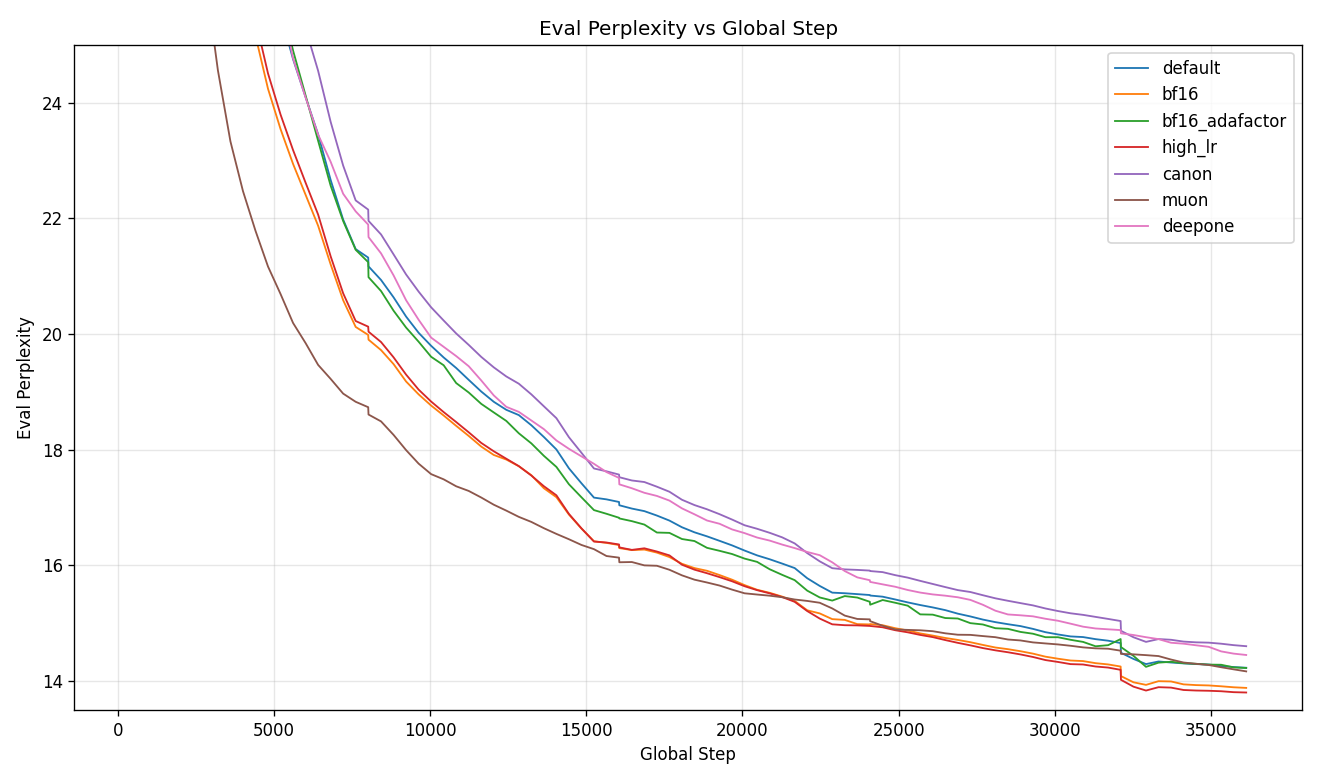
Same eval losses plotted as perplexity on a linear axis. The 1x runs have
fewer eval points than the 10x runs, so the outlier-clip percentile window
is more permissive; --y-max 25 is used here to force a comparable
y-range to the 10x plot so the tail-end differentiation is legible. Muon's
eval-perplexity curve is the most striking - it drops to the bottom of the
plot well before any other run gets there, then plateaus while the AdamW
runs catch up:
| Config | Best eval loss | Notes |
|---|---|---|
high_lr.yaml |
2.617 | AMP, lr = 3e-4. Highest non-diverging LR for AMP. |
bf16.yaml |
2.622 | Pure bf16 + SR, Forgather AdamW, lr = 4e-4. |
default.yaml |
~2.63 | Baseline. Shown via the first 1x slice of ten_chinchilla; not rerun separately. |
bf16_adafactor.yaml |
2.649 | Pure bf16 + SR, Adafactor, lr = 1e-3. |
muon.yaml |
2.650 | Muon optimizer (match_rms_adamw), lr = 6e-4. |
deepone.yaml |
2.668 | DeepOne medium with trainable ALiBi. |
canon.yaml |
2.678 | Custom Canon-A + NoPE variant. |
high_lr.yaml - output_models/high_lr
AMP run with PyTorch's AdamW at the highest LR that did not diverge in a
sweep (lr = 3e-4). Finished at the best eval loss of any 1x run, but
only modestly better than the default baseline - the default is already
close to the edge.
bf16.yaml - output_models/bf16
Pure bf16 weights + gradients with stochastic rounding, using Forgather's
AdamW (which defaults to SR when optimizer state is in bf16). Less robust
to high LRs than the SR Adafactor run - settled on lr = 4e-4 after a
sweep - but still tolerated a higher LR than AMP did.
Results confirm the general expectation from the SR paper: pure bf16 + SR can reach perplexity comparable to mixed precision, at a meaningfully lower optimizer-memory cost.
bf16_adafactor.yaml - output_models/bf16_adafactor
Same pure-bf16 + SR setup as bf16.yaml, but using Forgather's Adafactor.
This run was unusually stable at high LRs - we settled on lr = 1e-3
as the base, but had tried even higher values without diverging. The
grad-norms are visibly noisier than other configs, which suggests 1e-3
may still be above the statistical optimum. Finding the optimal LR for
this combination is a TODO.
canon.yaml - output_models/canon
The custom_canon model
(Canon-A only, NoPE, QK-Norm) at exact parameter count to the
baseline Llama medium. Finished with the highest eval loss of the 1x
runs, and throughput was lower than the baseline (~39 vs ~45-49
samp/s) - the opposite of what the 4M tiny-experiments ablation
predicted, where Canon-A alone runs ~9% faster than plain Llama.
Likely contributors: the causal-convolution kernel has not been
re-tuned for ~162M-scale models, and the LR was inherited from the
baseline rather than swept for this architecture.
The tiny_experiments/canon ablation also identifies stronger Canon
subsets at 4M than Canon-A alone: Canon-B has the lowest eval
loss of any subset (1.215, beating even full ABCD), and Canon-AC
has the best quality-per-throughput. Either is a more obvious next
variant to try at this scale than re-running Canon-A. See the
custom_canon/ README for design
rationale and follow-up suggestions.
muon.yaml - output_models/muon
Trains the baseline Llama medium with the Muon optimizer
(torch.optim:Muon) on the matrix parameters and AdamW on everything
else. lr = 6e-4, adjust_lr_fn = "match_rms_adamw" so the per-step RMS
update size is matched to AdamW's. Other defaults unchanged. Best eval
loss 2.650 at step 36460.
The result is a textbook example of Muon's training-vs-eval split at this
scale: the train loss drops dramatically faster than any AdamW run (the
Tiny Stories curriculum aside), and the eval-perplexity curve hits the
bottom of the plot well before the others. But by the end of the 1x
budget the AdamW runs have caught up, and muon finishes mid-pack rather
than ahead. Worth rerunning at a longer budget and/or with a different LR
schedule to see whether the early-training advantage extrapolates - Muon
is a candidate to fold into a final.yaml-style combined run.
This is consistent with the headline finding of Marek et al., Small Batch Size Training for Language Models: When Vanilla SGD Works, and Why Gradient Accumulation Is Wasteful (NeurIPS 2025): the gap between optimizers grows with batch size. Their Figure 1a is a hyperparameter-tuned grid over SGD, Adam, Adafactor, and Muon on a 30M model trained for 600M tokens (Chinchilla-optimal), at batch sizes from 1 to 4096 - at small batches all four optimizers cluster at nearly the same loss, and the spread only opens up at larger batches. This project runs Muon at an effective batch of 16 sequences (~65K tokens/step) on a ~162M model for ~2.27B tokens, and lands in the same regime: Muon's final eval loss is within ~0.03 of the best AdamW configuration despite a clearly steeper train-loss trajectory.
The examples/tiny_experiments/optimizers/
project explores this more thoroughly with a 30M Llama on FineWeb-Edu:
Muon wins by ~0.06 eval loss at both batch=32 (16K tokens/step) and at
8x grad-accumulation (131K tokens/step). The natural follow-up on this
project is to plug Muon into the 10x Chinchilla bundle - longer training
is the regime where Muon's lead over AdamW is reported to be more
durable, and a final.yaml-style combined run with Muon as the
optimizer is the obvious next experiment.
deepone.yaml - output_models/deepone
The previous default model: DeepOne-medium with trainable ALiBi. Best
eval loss 2.668 at step 36460. The eval curve sits near the top of
the bundle but is not far behind bf16_adafactor or muon.
Throughput is the lowest of the 1x runs (~38.9 samp/s vs ~45-49 for the
Llama variants). This is after the flex_attention + ALiBi
performance regression was fixed and a best-effort optimization pass
applied; with the regression in place the run was throughput-bound to
single-digit samp/s, which is why the project's default switched to
vanilla Llama. Most of the residual cost is the trainable ALiBi: the
slope parameters receive gradients, so the bias term cannot be folded
into the attention kernel as a constant and has to be carried through
the backward pass. Freezing the ALiBi slopes recovers most of the
throughput, but at this scale the eval-loss gap to Llama opens up
notably without the trainable variant - so DeepOne stays slow as long
as it stays competitive.
tiny_x_small_lm.yaml - moved to the 10x group
The curriculum-dataset config is now run at 10x Chinchilla + cooldown and
appears in the 10x table above. The original 1x run finished at eval loss
~2.66; extending the budget pulls the run into the 10x bundle (best eval
2.309), and the curriculum's strongest contribution shows up when
combined with WSD-S and lr = 3e-4 in final.yaml.
pp.yaml - not currently run end-to-end
The Pipeline Parallel variant of the baseline. Verified to start up, but
not yet run for a full training budget. A useful follow-up would be to add
a matching DDP config with dispatch_batches = True, so the DDP and PP
runs see exactly the same sequence of examples and can be compared
head-to-head.
Reproducing the plots
The four comparison plots above (10x_chinchilla_comparison.png,
10x_eval_perplexity.png, 1x_chinchilla_comparison.png,
1x_eval_perplexity.png) are rendered by
docs/plots/render.py - a small matplotlib
script using the forgather.ml.analysis.TrainingLog API. The CLI
forgather logs plot defaults are tuned for one or two runs; with the
five 10x and seven 1x runs collected here, the default markers and
linewidths obscure detail, so we render directly with thin lines, no
markers, and heavier smoothing on the train-loss panel.
The single-run LR trace still uses forgather logs plot, since one run
fits the CLI defaults fine:
# 10x ten_chinchilla alone, loss + LR on secondary axis.
# Single-run --loss-curves draws the LR trace; the outlier-aware y-axis
# default focuses on the tail instead of the warmup peak.
forgather logs plot \
    output_models/ten_chinchilla/runs/log_2026-04-02T00-02-58/trainer_logs.json \
    --loss-curves --smooth 10 \
    --output docs/plots/10x_ten_chinchilla_lr.png
Flags worth knowing (full reference in
docs/guides/logs-analysis.md):
| Flag | Purpose |
|---|---|
--loss-curves |
Train + eval loss panels; adds an LR trace on a secondary axis in single-run mode. |
--metrics NAME[,NAME...] |
Plot specific metrics instead of the default set. |
--compare LOG1 LOG2 ... |
Overlay multiple runs on the same axes. |
--labels L1 L2 ... |
Override per-run labels (order matches --compare). |
--smooth N |
Moving-average smoothing window (raw curve drawn faintly behind). |
--perplexity |
Convert loss-like metrics to exp(loss); relabel axes. |
--log-scale |
Log y-axis. Note: disables outlier-aware auto-clipping (log scale already handles dynamic range). |
--ignore-outliers / --no-ignore-outliers |
Default-on 5th/95th-percentile y-axis auto-clipping. Disable for the old full-range behaviour. |
--x-min, --x-max |
Clip the data to a step / epoch / time window. |
--y-min, --y-max |
Explicit y-axis limits; override auto-clipping. |
--grad-norm |
First-class grad-norm plot with optional smoothing and log scale. |
Parallelism
This project uses DDP by default. For the trainer-level details (dispatch-batches vs sharding, pipeline schedule selection, memory trade- offs, text-generation callback compatibility, etc.) see:
Everything those documents say about DDP, pipeline parallel schedule choice, compile-mode compatibility, memory optimisations, and the text-generation callback applies here without modification.
Monitoring and Control
# Tail the trainer log
tail -f output_models/<run>/runs/*/trainer_logs.json

# Summaries and plots
forgather logs summary --all --format one-line
forgather logs plot --loss-curves
forgather logs plot --compare run1/trainer_logs.json run2/trainer_logs.json

# TensorBoard across every model in output_models/
forgather tb --all                 # localhost only
forgather tb --all -- --bind_all   # all interfaces
External control of a running job (save / stop / abort / trigger
annealing) uses the standard forgather control commands - see
Trainer Control.
References
- LM Training Project template documentation
- full reference for every option exposed by the template this project extends.
- Trainer Options Reference - all training arguments and trainer constructor parameters.
- Pipeline Parallel guide
- Hoffmann et al. (2022) Training Compute-Optimal Large Language Models (Chinchilla). https://arxiv.org/abs/2203.15556
- Beyond Cosine Decay: On the effectiveness of Infinite Learning Rate Schedule for Continual Pre-training. (2025) https://arxiv.org/abs/2503.02844
- Wen et al. (2024) Understanding Warmup-Stable-Decay Learning Rates: A River Valley Loss Landscape Perspective. (WSD-S.) https://arxiv.org/abs/2410.05192
- Stochastic Rounding for LLM Training: Theory and Practice. (2025) https://arxiv.org/abs/2502.20566
- Marek et al. (2025) Small Batch Size Training for Language Models: When Vanilla SGD Works, and Why Gradient Accumulation Is Wasteful. (NeurIPS 2025.) https://arxiv.org/abs/2507.07101
- Jordan et al. (2024) Muon: An optimizer for hidden layers in neural networks. https://kellerjordan.github.io/posts/muon/
- SmolLM-Corpus
- Tiny Stories